A structure is dry when moisture readings say so - compared against the dry standard of an unaffected material in the same property. Drying here is a measurement discipline, not a waiting period.
Structural drying is the controlled drying of a water-damaged structure - its walls, floors, framing and contents - using airflow and dehumidification until moisture readings reach the dry standard.
Extraction removed the standing water. Drying removes what extraction cannot reach: the moisture inside the materials. This page covers the method, the science in plain language, drying times by class, and how dry is proven.
Structural drying is the controlled drying of a water-damaged structure - its walls, floors, framing and contents - using airflow and dehumidification until moisture readings reach the dry standard.
The dry standard is the anchor of the whole discipline: it is the moisture level of an unaffected material in the same property, measured at the start. Wet materials are dried until their readings match it. Three controls do the work - airflow across wet surfaces, dehumidification of the air, and the temperature that drives both - and readings, not calendars, decide when the job is done.
Baseline readings are taken from the wet materials and from an unaffected reference - that reference sets the dry standard. Wet areas are mapped, and equipment is planned by the loss's class. The output is a drying plan with a target reading for every material.
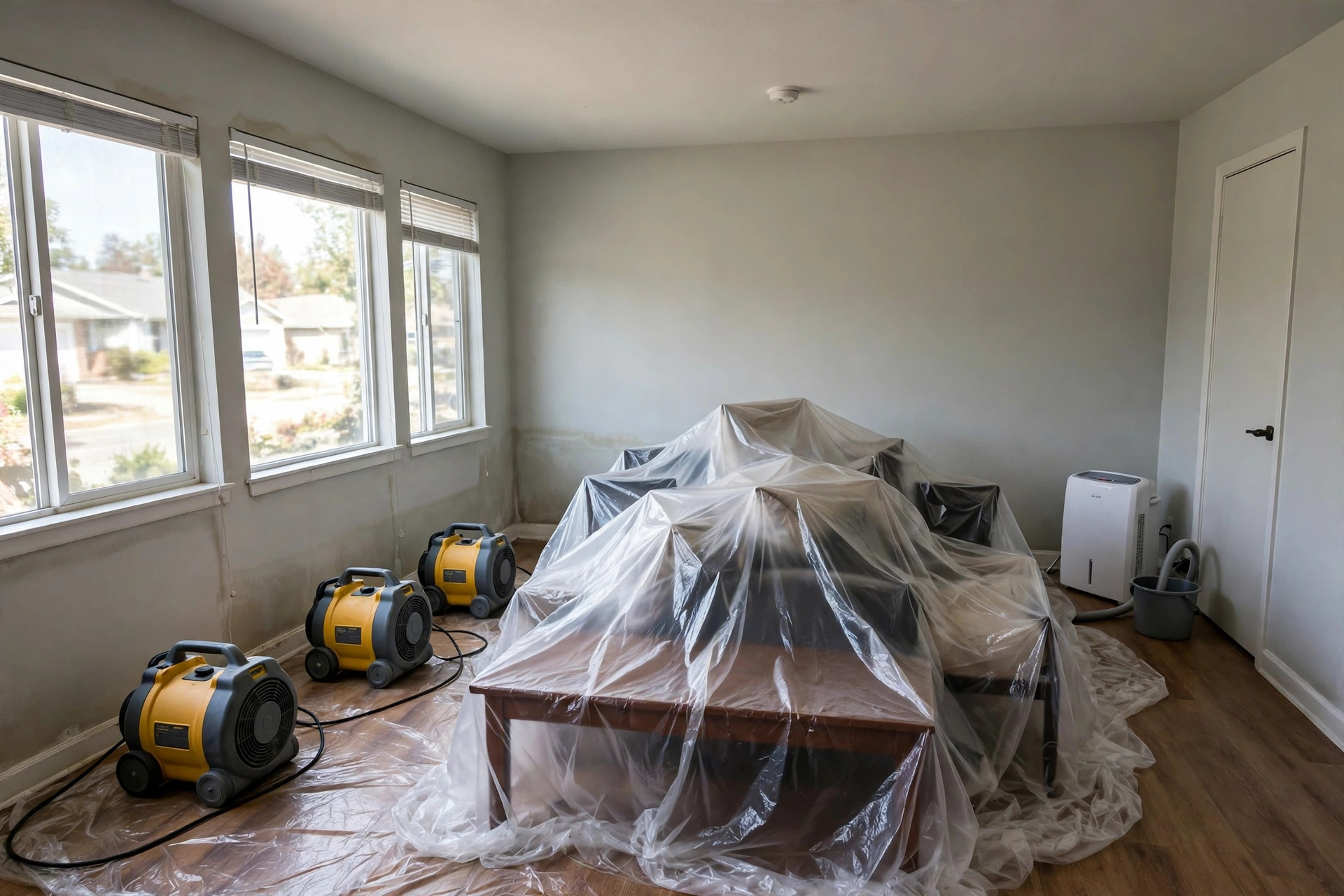
Air movers are placed to move air across every wet surface - walls, floors, and under cabinets where the plan requires. Moving air carries surface moisture into the room, where the next step removes it.
Dehumidification is sized to the class and volume: refrigerant (LGR) units for most residential losses, desiccant units for specialty and Class 4 conditions. The drying area is sealed where the plan requires a controlled chamber.
Readings are recorded daily for every material, the moisture map is updated, and equipment is repositioned or added wherever readings stall. The daily log joins the insurance documentation - your claim file shows a structure drying on a measured curve.
Every material is verified against the dry standard by meter. Only then does equipment come out. No wall is closed and no floor is laid over an unverified structure - verification is the gate to restoration.
The most common drying load. Drywall wicks water up from its base while insulation inside the cavity holds it - readings at the base and inside the cavity decide dry-in-place versus removal.
The Class 4 specialty case: hardwood binds water deeply and dries slowest, and cupping is its visible warning sign. Specialty methods and the longest timelines live here.
The Class 2 pattern - a whole room of carpet and pad. The pad follows the category rule; subfloor readings decide when flooring work can start.
The Class 3 pattern: water from above saturates ceilings, walls, insulation and subfloor. Safety first - saturated ceiling drywall can collapse, and the area below stays clear during drying.
Below-grade spaces dry last: cool surfaces, low airflow, concrete and subfloor assemblies. The full treatment is on our basement water damage page.
Drying is physics before it is equipment. Three working rules explain every decision on a drying job:
A wet material sits in a thin layer of still, saturated air, and evaporation stalls in it. Moving air replaces that layer continuously, so moisture keeps leaving the material. Rate follows exposed surface area - which is why baseboards and access points are opened where the plan requires.
LGR refrigerant units condense moisture on cold coils - the residential standard, efficient in warm conditions. Desiccant units absorb moisture into a desiccant material, work in cold spaces, and reach the lowest humidity for dense Class 4 materials. The class of the loss selects the machine.
Surfaces feel dry long before materials are dry inside - a wall can feel dry at the face and read wet at the base. Only meter readings against the dry standard settle it. Stop early, and the mold window reopens inside the assembly; lay flooring over a wet subfloor, and the floor fails. Readings are not paperwork - they are the job.
These are typical ranges for clean-water losses with professional equipment running continuously. The dry standard - verified by meter - ends the job, not the calendar.
| Class | Typical Drying Time | Why |
|---|---|---|
| Class 1 (least load) | Inside the 3 to 5 day range, often the short end | Small wet area, low-porosity materials |
| Class 2 (significant load) | Typically 3 to 5 days | Whole-room carpet, pad and wall load |
| Class 3 (greatest load) | Can extend to about 2 weeks | Ceilings, walls, insulation and subfloor saturated |
| Class 4 (bound water) | 10 to 14 days, sometimes longer | Water bound in dense materials - hardwood, plaster, concrete |
Typically 3 to 5 days for Class 1 and Class 2 clean-water losses with professional equipment running continuously - and the job ends when readings reach the dry standard, which extends Class 3 losses toward two weeks and Class 4 dense materials to 10 to 14 days.
The by-class table above is the evidence behind that answer. Conditions come after the answer, never before it: a drying job is finished by a meter, on a specific day, for a specific material - and the daily log shows it happening.
Restoration begins: removed materials are replaced by reconstruction, and packed-out contents return. If drying was delayed, or the water category was 2 or 3, mold assessment comes first. Nothing is rebuilt over an unverified structure - that gate is what the whole drying phase exists to protect.
When moisture meter readings for each wet material reach the dry standard - the level measured in an unaffected material in the same property - and hold there on the final check. Two popular tests do not work: touch (surfaces dry before interiors) and counting days (every material and class dries on its own curve).
No. Air movers and dehumidifiers run continuously until the dry standard is verified. Switching them off at night stalls evaporation, lets humidity climb back into the materials, and reopens the mold window the equipment is there to close. The daily readings show the progress the continuous run is buying.
Drywall is saved when the water was Category 1, the wall was caught inside the window, and cavity readings verify dry; it is removed when Category 2 or 3 water or saturated insulation is inside. Hardwood is often saved with specialty Class 4 drying when started fast - cupping can remain and is assessed honestly after drying. Category, time and readings decide; there are no blanket promises.
In effect, yes - it is the tool that achieves the EPA's prevention: wet materials dried inside 24 to 48 hours, and indoor humidity held below 60 percent (ideally 30 to 50 percent) afterward. The boundary matters: dehumidification prevents growth; it does not remove mold that has already grown. That is mold remediation.
24/7 emergency response, every day of the year
Local Buford team for Gwinnett and Hall counties
One team from mitigation to final restoration
Drying verified by moisture readings and moisture mapping
Documentation prepared for your insurance claim
Clear next steps and updates at every stage
Based in Buford (ZIPs 30515, 30518, 30519), serving Gwinnett and Hall counties. The full service-area treatment is on the homepage.
If your Buford home or business needs structural drying, one call starts the work today - (470) 516-0618.