For a business, water damage is two emergencies at once: the water, and the downtime. Commercial restoration answers both - phased around your hours, zoned so unaffected areas keep working, documented for everyone who will ask.
Commercial water damage restoration is the mitigation, drying, cleanup and repair of water damage in business properties - offices, retail spaces, restaurants, warehouses and commercial buildings.
The technical phases are the residential network's phases. What changes is everything around them: scale, scheduling, and a documentation chain that serves owners, managers, landlords and insurers at once.
Commercial water damage restoration is the mitigation, drying, cleanup and repair of water damage in business properties - offices, retail spaces, restaurants, warehouses and commercial buildings.
Two differences define the segment, stated as facts of the work. Scale: larger areas, larger volumes, building systems instead of household ones. Continuity: the work is planned around the business's operation and its documentation duties, from the first visit. Mitigation to restoration, under those two differences, is the whole definition.
The source is stopped, and the assessment runs on two tracks at once: the moisture track (readings and a map, the network canon) and the continuity track - which areas must keep operating, which close, and what the insurer and property manager need documented. Both plans are outputs of this step.
Larger volumes and areas are extracted with multiple points running in parallel, zoned so unaffected areas stay usable where the water category allows. The general method is on our emergency water extraction page.
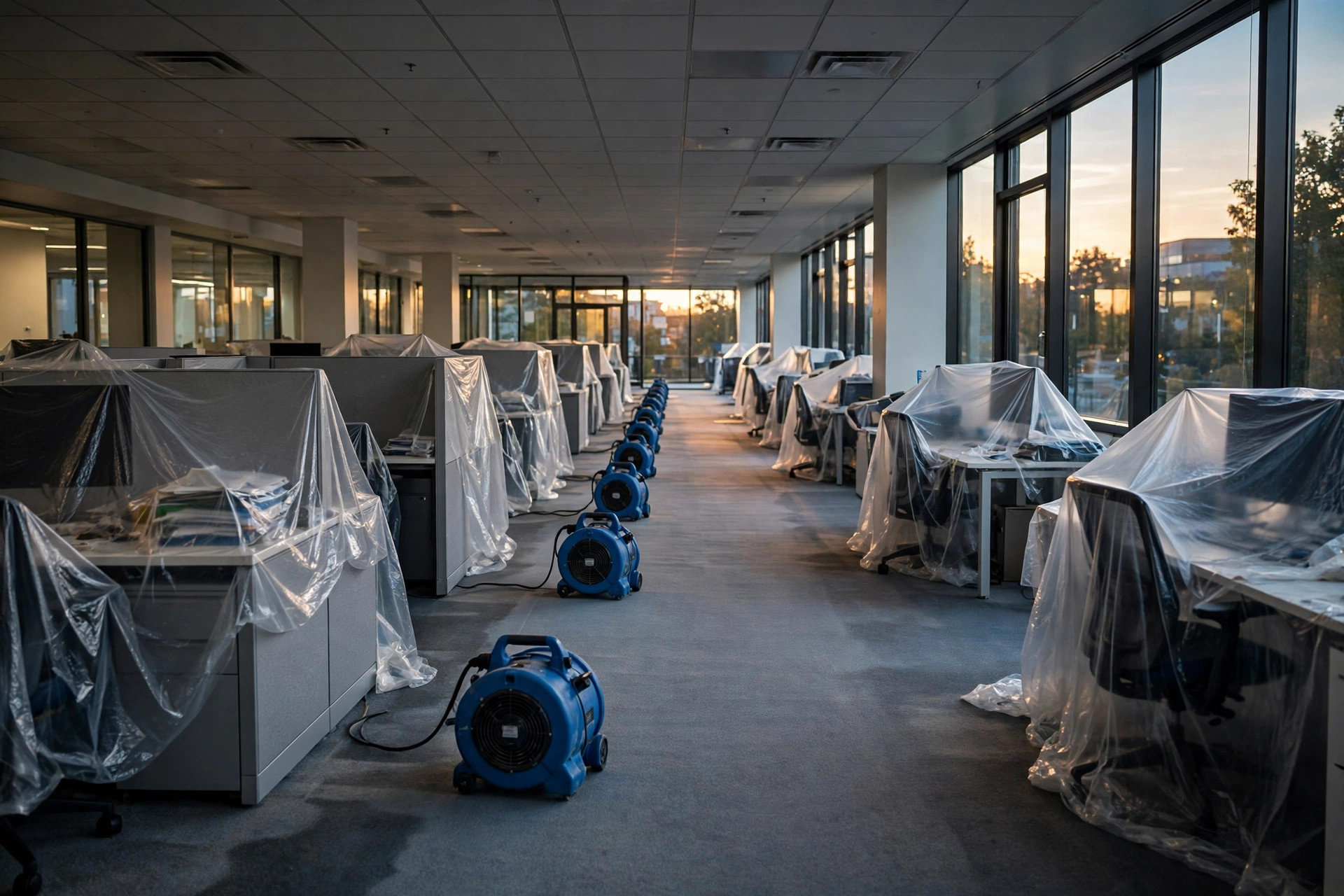
Drying is phased by zone, with equipment scheduled around business hours where the continuity plan requires it, and readings logged per zone for the documentation file. A zone is done when its readings verify dry - the same gate as any job on this site.
Affected areas are cleaned and disinfected to the reopening standard of the property type. A restaurant's bar differs from a warehouse's, and health-code specifics belong to the operator and the inspector - stated honestly, because invented regulatory claims help no one's reopening.
The complete file - photos, readings, map, scope, continuity log - is delivered to the business, its insurer and its property manager. Restoration proceeds from the scope, and reopening follows the verified, cleaned zones in phases.
Pipe, HVAC and roof water in working offices. Phased drying runs around staff, and documents and equipment are protected under contents discipline at commercial scale.
Retail's clock is trading hours, and stock protection and phased zones are its named priorities. The Mall of Georgia - the state's largest mall - anchors Buford's retail map.
Water heaters, dish areas, restrooms and supply lines are the restaurant sources. Reopening hygiene is framed by step four's honest sentence: the standard is real, and the inspector owns it.
Volume is the warehouse problem - large floor areas, racking, stored goods. Zoned extraction and drying are the method, and contents at scale are inventoried like any other contents job.
Appointment businesses measure closure in cancelled days. Documentation and phased operation are the priorities here - scheduling and records, with no compliance claims made or implied.
The technical phases are identical. What changes is everything around them:
| Factor | Residential | Commercial |
|---|---|---|
| Primary pressure | Habitability and belongings | Downtime and revenue |
| Work scheduling | Around the household | Around operating hours, phased by zone |
| Documentation | The homeowner's claim | Insurer, landlord and property manager chain |
| Scale of drying | Rooms | Zones and building systems |
| Decision makers | The owner | Manager, ownership and insurer together |
When a loss spans multiple units or a whole building, the work is organised by zone with one documentation chain per affected tenancy - readings and maps per unit, source control at the level of building systems, and a single coordination point for ownership and property management. Hotels, multi-unit and apartment properties follow the same pattern.
No catastrophe-team branding appears on this page, and no fleet claims - the large-loss capability is described as method, because method is what a property manager can actually verify from a scope and a log.
In phases - and the phases are the honest answer. Unaffected zones reopen as soon as they are verified safe and dry, often while affected zones are still drying, because the work is zoned from step one. Affected zones reopen when they reach the same gates as any job on this site: extracted, disinfected where the category requires, verified dry.
A whole-property timeline follows the scope and the standard drying ranges, decided by area, category and how much finish must be rebuilt. No day-count is promised for an entire business, because the phased reopening - not a date - is what actually protects the revenue.
The emergency visit: source stopped, continuity plan agreed, extraction begins. The drying days: zoned equipment, daily per-zone readings, the business operating wherever the phasing allows. Then the gates, zone by zone: verified dry, cleaned, documented. The file is handed over complete, and reconstruction proceeds from the scope. Steps one to five above are this timeline at full length.
Yes. Commercial work is scheduled around the business - including nights and weekends where the continuity plan requires it. The locked fact underneath is the 24/7 emergency response; the scheduling detail for your property is set in its step-one plan, not in a slogan on this page.
Commercial property policies generally address sudden and accidental water events - burst pipes, appliance failures - as residential policies do, and they exclude flood the same way, absent separate flood cover, and gradual damage the same way again. Business-interruption cover is a separate policy element and varies - stated as variable, never promised. The step-five documentation file is what serves the claim either way.
Yes - mitigation through reconstruction under one documentation chain, which matters more commercially than anywhere: the file serves the business, its insurer and its property manager without changing hands. The residential form of this answer lives on the reconstruction page; commercially, the chain is the point.
24/7 emergency response, every day of the year
Local Buford team for Gwinnett and Hall counties
One team from mitigation to final restoration
Drying verified by moisture readings and moisture mapping
Documentation prepared for your insurance claim
Clear next steps and updates at every stage
Based in Buford (ZIPs 30515, 30518, 30519), serving Gwinnett and Hall counties. The full service-area treatment is on the homepage.
If your Buford home or business needs commercial water damage restoration, one call starts the work today - (470) 516-0618.